
High-Current Pin Headers in NEV Low-Voltage Electronics and Power Modules
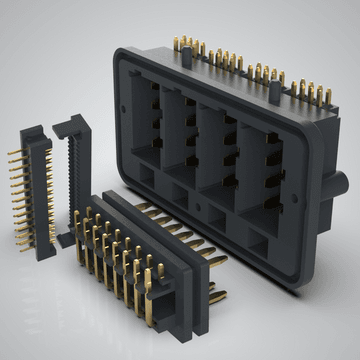
Split “high current” from “high voltage”
NEV wiring includes charge inlets, e-axle phases, PDUs and HVIL — those are HV systems (often discussed under GB 18384 class B). Pin headers sit on the LV electronics: BMS sense-to-controller, OBC control-to-aux, MCU 12V/5V, cabin modules. Catalog lines such as “2.00mm dual-row, ~3A/pin, gold, −40 to 105°C” belong here, not on the pack main loop.
The same split applies to industrial PSUs, LED drivers and PV inverter control/sense boards: bulk power on terminals or busbars; control rails, fans and coils on headers.
How to read the catalog amp
A typical 2.54mm header is quoted near 3A at ~25°C ambient with a 30K rise (EIA-364-70 style). Dense housings, all pins hot, 85°C cabin air and no airflow require derating. LV automotive and industrial practice is 50–70% of catalog for continuous current, with return pins no fewer than supply pins. 1.27mm is for signals and tiny aux rails, not pre-driver power.
A pin-count you can put on a drawing
- I1 = catalog × derate (e.g. 3A × 0.6 = 1.8A).
- n = ceil( Iload / I1 × 1.25 ); the 1.25 covers uneven resistance and one open pin.
- Return pins ≥ supply pins, paired on the outside or symmetrically.
- Feed each pin with adequate copper before they star together, so one skinny trace does not hog current.
Example: 8A continuous on 2.54mm. I1=1.8A → about six supply pins and at least six grounds. If you need tens of amps continuous, step up to a power terminal family instead of growing an endless pin field.
NEV LV extras
- Vibration: THT beats pure SMT; pegs or screws so solder is not the latch.
- Gold on the contact for sulfur and salt; tin on the solder tail; write thickness.
- Check long-term plastic temperature, not only reflow peak.
- Keep HV busbars off the header; draw creepage blanks in the footprint.
Junjia 2.54/2.00mm headers fit aux and signal board-to-board. Put continuous current, ambient, vibration and which HV family you already use on the RFQ so traction current never lands on a pin net.